Bottom Line Up Front:
Your unit has to start planning to shoot the IWTS tables. It is relatively resource intensive compared to most previous unit basic rifle marksmanship (BRM) training plans, but it produces more effective shooters.
Table I requires a PMI, a short (less than 20 questions) written test, and a practical that shows a Soldier can safely manipulate their weapon. Soldiers should be tested on ammunition identification, weapons safety statuses, rules of firearms safety and other similar topics.
Table II uses digital aids like the Engagement Skills Trainer (EST) to help Soldiers rehearse the course of fire, the positions and holds, and the fundamentals of marksmanship with little overhead or resource planning necessary. It is required. Additionally, Soldiers can “shoot” their nighttime and CBRN quals using a simulator, or they can shoot them as part of the final Qualification, Table VI, with real ammo.
Table III is the final “dry” table and is where Soldiers complete a series of physical drills with their assigned weapon to demonstrate proficiency in weapons handling and movement. These drills include moving from prone to standing and back down safely, transitioning from a primary to a secondary weapon safely (if assigned), carrying positions and loading and reloading the weapon.
Table IV is the first live fire table and is where Soldiers group, zero, confirm at distance and demonstrate “application of hold-offs”: After completion of confirmation at distance stage the Soldier must successfully hit a properly presented 100 meter E-type target with a minimum of four of five (80-percent) shots then the Soldier must also successfully hit a properly presented 200 meter E-type target with a minimum of four of five (80-percent) shots.”
Table V should be more difficult than the actual qualification, Table VI. During Table V Commanders should run their Soldiers through challenging scenarios, preparing them for the easier pace of Table VI.
Table VI is the final qualification. By this point, Soldiers should understand exactly what is going to be asked of them and be able to perform it well. Soldiers should have zeroed weapons that they are comfortable employing over an understood and rehearsed course of fire.
The qualification is good for one year, with a Colonel or higher permitted to sign off on a six month extension using an Alt-C target. Alt-C qualifications no longer exist. Commanders should designate a Master Marksmanship Trainer (MMT) to oversee the BRM process. This MMT can attend formal Master Gunner or MMT training or can simply be a knowledgeable NCO already in the unit, but this person must be designated and put on orders so they can oversee the program and ensure the Commander’s intent is being executed.
Units and individuals can also be deemed unqualified based on what is referred to as ‘condemnation criteria.’ For unit level training, this can be key-leader turnover – if two key leaders leave (a Commander and First Sergeant, for example), then the subordinate unit is now unqualified. Additionally, the MMT or the Commander can assess the individual or unit and deem them unqualified. Generally, the IWTS has the certifying official be a key leader two levels higher than the unit or individual being trained.
TC 3-20.0, Integrated Weapons Training Strategy, discusses individual weapons qualification on page 3-9.
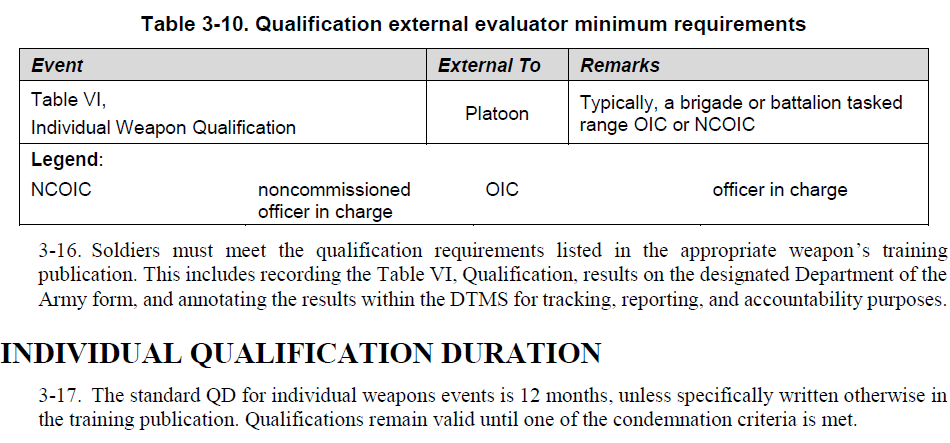
Soldiers are not authorized to make multiple attempts at qualifying within the training period. Soldiers qualifying within the same four month period may only receive the ‘qualified’ rating.
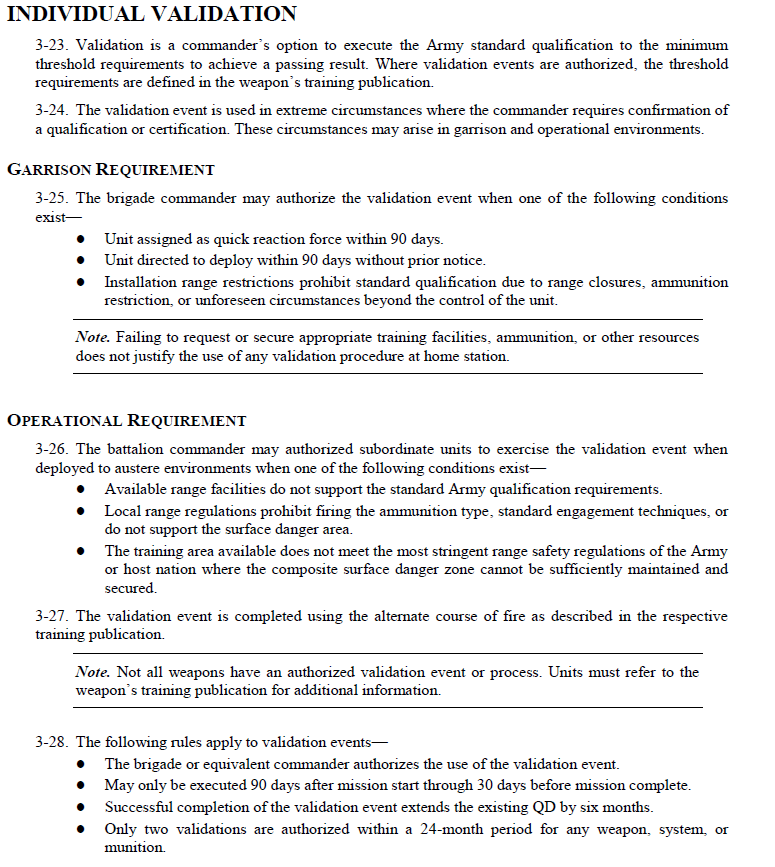
Please continue on to the following links to better understand each table individually.
 The Integrated Weapons Training Strategy Explained